Saturday, February 28, 2015

American Open Round 6: Austin Powers Past the Moscow

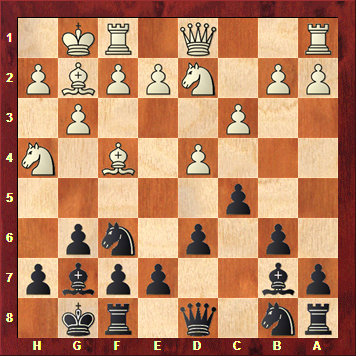
In round 6 of the American Open in November, I played Austin Hughes, rated 2195. Although I had the white pieces he was the clear favorite in my mind going into the game (actually, that's probably not a good state of mind to be in!). He has been rated over 2200 before and I had lost a game to him a number of years ago, albeit when we were both rated quite a bit lower.

1. e4 c5 2. Nf3 d6 3. Bb5+ Bd7 4. Bxd7+ Qxd7


This is the Moscow Variation of the Sicilian, which I started playing years ago when Larry Kaufman recommended it in his interesting book The Chess Advantage in Black and White. I use it primarily as a way to avoid playing against the Najdorf but, like all of my openings, I don't necessarily play it against all opponents. It just depends on their rating and/or if I have a good idea of their opening repertoire.

Black's third move is not forced. Both 3. ... Nc6  and, even better, 3. ... Nd7  are possible. Either way, it has to be said that white voluntarily giving up his light squared bishop in the Sicilian is a bit controversial. However, he does gain some time and note that none of black's kingside pieces have moved yet.

5. O-O Nf6 6. Re1


Kaufman prefers to play 6. Qe2  followed by bringing the rook from f1 to d1, which I have also played many times. Both 6. Re1  and 6. Qe2  are the main lines here.

6. ... Nc6 7. c3 g6 8. d4 cxd4 9. cxd4 Bg7 10. Nc3 O-O 11. h3 Rad8 12. Bg5 h6 13. Be3


This look fairly natural but Fritz thinks that 13. Bxf6 Bxf6 14. Nd5! Bg7 15. Rc1  is best, with a half pawn advantage to white. However, giving up the dark squared bishop is hard for a human player to do and I think 13. Be3  is a reasonable practical choice.

13. ... d5 14. e5 Ne4 15. Nxe4?


So far, white has been ticking along nicely and had his usual slight advantage out of the opening. White's 15th move is a serious positional mistake, which will end up giving black a juicy square on f5 for his knight, control over the d file, and a central pawn majority. The simple 15. Rc1  was both natural and good, preserving a very minor edge for white. I am not sure why I didn't play this. True, it looks annoying to allow black's knight to sit on e4 but it's not the end of the world. White would still have plenty of reasonable ideas after 15. Rc1, e.g. bringing the queen to b3 or d3 (after playing a3), or to c1 to target the h6 pawn.

15. ... dxe4 16. Nd2 Nxd4 17. Nxe4 Bxe5 18. Bxh6 Rfe8 19. Rc1 Nf5 20. Qxd7?


Very careless. The position is unpleasant but still tenable for white after 20. Qe2!, with the point that 20. ... Nxh6  doesn't win a piece because of 21. Nc5!  when white will pick up to loose bishop on e5. After the text move, white will simply end up down a pawn with a much worse position. The rest of the game is simple for Austin.

20. ... Rxd7 21. Bd2 Bxb2 22. Rc2 Bg7 23. Bg5 Red8 24. Kf1 b6 25. g4 Nd4 26. Rd2 Nf3 27. Rxd7 Rxd7 28. Re3 Nxg5 29. Nxg5 Bh6 0-1

White can save the exchange with 30. f4  but, after black plays Rd4 and e5, everything is falling apart (and black is still up a healthy pawn anyway).

Although this was a disappointing game, the truth is it all stemmed from one bad decision (15. Nxe4) which gave me an uncomfortable, but still playable, position. As is common in chess, one poor move then led to another (20. Qxd7), after which black was just winning.

I decided to withdraw from the tournament after this loss. Having taken byes in the first two rounds, I would have been out of contention for any prizes and the venue was quite a commute from home. I have withdrawn from tournaments before the last round, or the last couple of rounds, quite often but it's a policy I may rethink. Perhaps it is better to play as many games as possible, particularly in a section like this one was (under 2200), when I get still get some good opponents in the last round or two.

Here is the full PGN of the game vs Austin Hughes:

(594) Hayes,Matthew (2133) - Hughes,Austin (2195) [B52]
American Open Orange (6), 29.11.2014

1.e4 c5 2.Nf3 d6 3.Bb5+ Bd7 4.Bxd7+ Qxd7 5.0–0 Nf6 6.Re1 Nc6 7.c3 g6 8.d4 cxd4 9.cxd4 Bg7 10.Nc3 0–0 11.h3 Rad8 12.Bg5 h6 13.Be3 d5 14.e5 Ne4 15.Nxe4 dxe4 16.Nd2 Nxd4 17.Nxe4 Bxe5 18.Bxh6 Rfe8 19.Rc1 Nf5 20.Qxd7 Rxd7 21.Bd2 Bxb2 22.Rc2 Bg7 23.Bg5 Red8 24.Kf1 b6 25.g4 Nd4 26.Rd2 Nf3 27.Rxd7 Rxd7 28.Re3 Nxg5 29.Nxg5 Bh6 0–1


Saturday, February 21, 2015

An Interesting New Chess Clock

I recently stumbled upon a terrific looking new chess clock that is in its final development stages. Developed by Shelby Lohrman, he recently trialed the clock at the Amateur Team East tournament. There is a thread on the USCF website about the clock which seems to have generated a slightly negative reaction, which surprised me. Some people said the clock didn't have enough presets, others said it was going to be too expensive. Well, for one the clock is still in the beta stages and it's possible more presets will be added. Secondly, you can always customize the time controls and save them as favorites. Finally, the suggested prices being thrown around were roughly comparable with the Chronos, which would be this clock's main competitor. As a Chronos owner myself, I know how hard it can be to set properly. I am now used to it but, every now and then, I have to consult the manual if I need to set it to an unusual time control.


Lohrman has three videos up on YouTube about the as yet unnamed clock. From what I can see, it offers several advantages over the Chronos:

1) Easier to set
2) Larger display that includes a second line of text that shows information about the time control, can show a move counter, etc.
3) The ability to copy settings and presets from one clock to another
4) An external battery cover (us Chronos owners know what a hassle it is to have to carry a screwdriver in our chess bags!)

So far, I can see a few disadvantages to the Chronos as well:

1) It seems to have far fewer presets, as forum posters have noted, but my hope is that will change as the clock gets closer to its launch date
2) The price is likely to be comparable to the Chronos but, as the Chronos price seems to have decreased in recent months, the new clock might end up being more expensive
3) It uses the older Chronos style plunger buttons which are great for tactile feedback but wear out more easily

I should also note that I have no idea what the build quality will be like. Those who saw the clock at the Amateur Team East can perhaps attest to that. From the videos, however, it looks sturdy and it very much resembles the Chronos, just with a larger display.

I will be keeping an eye on developments with the clock with keen interest.

Here is a link to a YouTube video introducing the clock:

https://www.youtube.com/watch?v=P3huaFY0L9o

American Open Round 5 - Dual (or Duel?) Analysis

In round 5 of the American Open in November, I faced off against Abhishek Handigol, an expert rated 2067. He'd had a terrific tournament so far, winning his first three games before coming unstuck against Agata Bykovtsev. Unfortunately for Abhishek, he made some risky, unsound moves against me, particularly leading up to the time control, which left him in a lost position.

Interestingly, Abhishek posted this game on a round-by-round analysis he did of his American Open tournament in his blog on chess.com. I have added some of his comments to mine below.

1. e4 c5 2. Nf3 g6 3. c3 Bg7 4. d4 cxd4 5. cxd4 d5 6. exd5 Nf6

Obviously, I attempted to go into the Accelerated Dragon but white had other ideas. The position has transposed into some sort of Grunfeld. Abhishek said that next time he will play 6. e5  in this position, a move that is certainly more aggressive but Fritz rates it about the same as 6. exd5. A pawn being on e5 isn't as disruptive for black as one might think because the knight on g8 will come into the game via h6 or e7 to f5.

7. Nc3 Nxd5


Abhishek commented that this position now resembles a Caro-Kann, which I can see. The Panov-Botvninik Attack would have a similar structure.

8. Bc4 Nb6 9. Bb3 O-O 10. O-O Bg4 11. d5 N8d7 12. h3 Bxf3 13. Qxf3 Nc5


The computer prefers 13. ... Ne5, with an equal position. After the text move, Fritz thinks white is at about +0.3 but there's not much in it. To my mind, Ne5 was a more natural human move because it attacks the queen, but actually putting the knight on c5 makes a lot of sense because it pressurizes a key defender of the d5 pawn. White would have to acquiesce to a trade of knight for bishop or put the bishop on the inferior c2 square where it's not clear what it is doing.

14. Bc2 Rc8 15. Rd1 Nc4 16. Qe2 Nd6


Blockading a pawn with a knight like this is a key motif, "in the style of Nimzovich" as Abhishek noted. The pawn on d5 isn't truly passed because of black's e7 pawn but the knight is useful on d6 because we don't want white to have any encouragement to push the pawn to d6 himself at some point. The knight may also have the option to come to f5 after a late Qd7 to support it.

17. Bg5 Re8 18. Rac1 a6 19. Na4 Nd7 20. Bb3 b5 21. Rxc8 Nxc8 22. Nc3 Nf6 23. Bxf6?


For me, this is the first real questionable move of the game. I can see no justification for white exchanging off his dark squared bishop like this, at least not for a knight. Abhishek said, "I think it was more wise to avoid trades here. Even if the knight gets to d6 it's just a blockader." I agree it was wise to not trade bishop for knight but don't understand his comment about the knight getting to d6. Surely it's the knight on c8 that will just go to d6 in one move?

23. ... Bxf6 24. Ne4 Bg7 25. a4 Nd6 26. axb5 Nxe4 27. Qxe4 axb5 28. Qb4 Qb8


It looks like black is tied up but, at the time, I thought the position was equal. Fritz agrees, giving a slight advantage to black (about -0.2) but nothing too special. True, black's queen has to defend the pawn on b5 but it's hard for white to attack it with a second piece. White also has to contend with defending the b2 pawn.

29. Re1 Be5 30. f4??


A blunder that essentially costs white the game. I think Abhishek just missed my next, simple move. White needs a plan and I think that was his problem; he wasn't sure what to do and so tried to make things tactical but it backfired. Abhishek said of this move, "Lesson learned: If I DON'T know what to do, just do nothing." Well, I'm not sure it's as easy as that because passing isn't an option in chess (if it was, stalemate and zugzwang wouldn't exist!) but white didn't need to lash out like this. Fritz thinks that both 30. h4  and 30. g3  are reasonable, rating the position as a bit better for black but nothing that white shouldn't be able to handle.

30. ... Bd6! 31. Qe4 Bxf4 32. d6 Qxd6


White was already down a pawn but this just compounds the error. White gets some tactical shots in but still ends up in a lost position.

33. Bxf7+ Kxf7 34. Rf1 e5 35. g3 Re6 36. gxf4 exf4


Abhishek said, "Now I'm down a pawn. whoops. I should have just sat around in time pressure. He was also in pressure so it could have affected him also." True, I get into time trouble so often that, although I should be used to it, it does affect my play.

37. Qxf4+?

Taking with the rook was better. Exchanging queens leads to an endgame that is likely just losing for white.

37. ... Qxf4 38. Rxf4+ Ke7 39. Rb4 Re5 40. Kf2 Kd6 41. Kf3 Kc5 42. Rg4 b4 43. b3 Re1 44. Rc4+ Kb5 45. Rd4?


Now the position really is just winning for black.

45. ... Rc1 46. Rd7 Rc3+ 47. Kg4 h5+ 48. Kh4 Rxb3 49. Rb7+ Kc4 50. Rg7 Rd3 51. Rxg6 Rd5 52. Rc6+ Rc5 53. Rf6 b3 54. Rf4+ Kc3 55. Rf3+ Kb4 56. Rf1 b2 57. Rb1 Kb3 58. Rf1 Rc1 59. Rf3+ Rc3 60. Rf1 Ka2 61. Rf2 Ka1 62. Rf1+ b1=Q


White should resign but he plays on until the bitter end, trying for a couple of stalemate tricks. Ordinarily, I would say this was rather cheap but he had nothing to lose. The game was up anyway.

63. Rf5 Rxh3+ 64. Kg5 Qxf5+ 65. Kh6 Qf6+ 66. Kh7 Rc3 67. Kg8 Rc8+ 68. Kh7 Rh8# 0-1

Here is PGN:

(593) Handigol,Abhishek (2067) - Hayes,Matthew (2133) [D94]
American Open Orange (5), 29.11.2014

1.e4 c5 2.Nf3 g6 3.c3 Bg7 4.d4 cxd4 5.cxd4 d5 6.exd5 Nf6 7.Nc3 Nxd5 8.Bc4 Nb6 9.Bb3 0–0 10.0–0 Bg4 11.d5 N8d7 12.h3 Bxf3 13.Qxf3 Nc5 14.Bc2 Rc8 15.Rd1 Nc4 16.Qe2 Nd6 17.Bg5 Re8 18.Rac1 a6 19.Na4 Nd7 20.Bb3 b5 21.Rxc8 Nxc8 22.Nc3 Nf6 23.Bxf6 Bxf6 24.Ne4 Bg7 25.a4 Nd6 26.axb5 Nxe4 27.Qxe4 axb5 28.Qb4 Qb8 29.Re1 Be5 30.f4 Bd6 31.Qe4 Bxf4 32.d6 Qxd6 33.Bxf7+ Kxf7 34.Rf1 e5 35.g3 Re6 36.gxf4 exf4 37.Qxf4+ Qxf4 38.Rxf4+ Ke7 39.Rb4 Re5 40.Kf2 Kd6 41.Kf3 Kc5 42.Rg4 b4 43.b3 Re1 44.Rc4+ Kb5 45.Rd4 Rc1 46.Rd7 Rc3+ 47.Kg4 h5+ 48.Kh4 Rxb3 49.Rb7+ Kc4 50.Rg7 Rd3 51.Rxg6 Rd5 52.Rc6+ Rc5 53.Rf6 b3 54.Rf4+ Kc3 55.Rf3+ Kb4 56.Rf1 b2 57.Rb1 Kb3 58.Rf1 Rc1 59.Rf3+ Rc3 60.Rf1 Ka2 61.Rf2 Ka1 62.Rf1+ b1Q 63.Rf5 Rxh3+ 64.Kg5 Qxf5+ 65.Kh6 Qf6+ 66.Kh7 Rc3 67.Kg8 Rc8+ 68.Kh7 Rh8# 0–1


Friday, February 20, 2015

American Open Round 4

I haven't posted in a while, again having been busy with work and life in general. Continuing from where I left off in my last blog post, I played in the American Open in November 2014. After beating Randy Hough in round 3 (following byes in the first two rounds), I had white against Joseph Warhula, rated 1926. I had seen Joseph on the tournament scene for years but we had never played before. The game was a Scandinavian and one where I was always at least slightly better and in control for the entire game. It's always nice when that happens!

1. e4 d5 2. exd5 Qxd5 3. Nf3 Bg4

This is probably the move I see most often in this line. I think it's a natural move but harmless enough. 3. ... Bf5  can also be played but is possibly less accurate.

4. Be2 Nf6 5. d4 c6 6. O-O e6 7. Bf4 Be7 8. Nc3


Slightly unusual for me. I typically play c4, if not here than earlier. However, I was reminded of something Jesse Kraai said, namely that you don't want to make unnecessary pawn moves. That means that Nc3 is better on general principles because it develops a piece with tempo, although the c4 push is also good it has to be said. I wanted to do something a bit different here, hence 8. Nc3.

8. ... Qa5 9. Re1 Nbd7 10. a3 Nd5 11. Nxd5 cxd5 12. Ne5 Bxe2 13. Qxe2 Nxe5 14. Bxe5 Bf6 15. Bxf6 gxf6 16. Qf3 Qd8 17. Re3 Rc8 18. Qh5


Black is already in serious trouble. There are mounting threats against the weak points on f7 and e6. White already threatens to play Rxe6+ which would be crushing.

18. Qh5 Qb6 19. Rae1 Ke7 20. Qh4?!


Fritz isn't crazy about this move. The point is that, yes white is threatening to play Rf3 next move and hit the f6 pawn. Unfortunately, black can easily prevent this via 20. ... h5  and 21. ... Rh6. It looks ugly but I can't see an immediate way for white to exploit the strange placement of black's kingside pieces. Luckily for me, my opponent panicked and blundered a pawn.

20. ... Rhg8? 21. Qxh7 Rh8??


Black is probably lost anyway but this move seals the deal. Black will have two rooks vs the queen but his pawns are vulnerable and scattered; just the kind of position a hungry queen enjoys.

22. Rxe6+ Qxe6 23. Rxe6+ Kxe6 24. Qd3 Rh4 25. c3 Rc6 26. f3 a6 27. g4 1-0

Here is the complete PGN:

(592) Hayes,Matthew (2133) - Warhula,Joseph (1926) [B01]
American Open Orange (4), 28.11.2014

1.e4 d5 2.exd5 Qxd5 3.Nf3 Bg4 4.Be2 Nf6 5.d4 c6 6.0–0 e6 7.Bf4 Be7 8.Nc3 Qa5 9.Re1 Nbd7 10.a3 Nd5 11.Nxd5 cxd5 12.Ne5 Bxe2 13.Qxe2 Nxe5 14.Bxe5 Bf6 15.Bxf6 gxf6 16.Qf3 Qd8 17.Re3 Rc8 18.Qh5 Qb6 19.Rae1 Ke7 20.Qh4 Rhg8 21.Qxh7 Rh8 22.Rxe6+ Qxe6 23.Rxe6+ Kxe6 24.Qd3 Rh4 25.c3 Rc6 26.f3 a6 27.g4 1–0


Sunday, January 4, 2015

2014 American Open - An Old Familiar Foe

I played in the American Open over the Thanksgiving weekend, a tournament I played in several times before. The full schedule would be a four day event with two rounds per day. I decided to take byes in the first two rounds so that I didn't have to play on Thanksgiving. True, I could have played in the three day schedule but the first few rounds were played at a faster time control. I have enough issues with time trouble as it is without tempting fate! Besides, I would prefer to play six longer games that are likely to be of a higher quality. Had I been desperate to win a prize then I would not have taken the byes but I didn't mind not winning any money. I was in for the experience, not the cash.

On the Friday after Thanksgiving, I turned up for round 3 (again, I took byes in rounds 1 and 2) to find I was paired against Randy Hough. I have known Randy since 2004, when we first locked horns in the Paso Robles Winter Open (a game that he won). Randy plays in Arcadia and we have played several times before. We also played earlier in 2014 in the Lina Grumette Memorial Day tournament.

Before the game, I got to meet Randy's brother and sister-in-law who were in town for the holidays. They were both very nice and seemed quite interested in the tournament and how it was run. They even insisted on taking photos before the game started! Actually, the pairings weren't up yet when I first started chatting with them and Randy and I joked how it would be funny if we had to play each other.

In our game earlier in the year I got the white pieces. This time, I had black.

1. d4 Nf6 2. c4 e6 3. g3 d5 4. Nf3 h6 5. Bg2 Bd6 6. O-O O-O 7. Qc2 c6


So far we've had a fairly typical Catalan but my 7th move isn't best. 7. ... c5  would be more dynamic, challenging white's center, and is Fritz's preferred move.

8. Nbd2 Nbd7 9. e4 dxe4 10. Nxe4 Nxe4 11. Qxe4 Nf6 12. Qe2 c5?


I finally got the c5 break in that I should have played five moves ago. Unfortunately, it's not so good now. In fact, Fritz doesn't like it at all, probably because it's losing a tempo and also giving white's g2 bishop a nice looking diagonal.

13. Rd1 Qe7 14. dxc5 Bxc5 15. Ne5! a5!


The idea is to develop the queen's rook to a6, where it might be useful. Otherwise, I have no easy way to complete my development. Fritz needs a couple of minutes to see this move but eventually rates it as it's second choice. After the text move, the computer says the position is almost +1.5 in white's favor, which should be virtually winning. True, white is not up any material but he has all the positional trumps. My queenside is still not yet fully developed, he has a fantastic knight on e5 that is hard to kick away, and my light squared bishop is a particular problem that will take at least a couple of moves for me to solve.

White's plan should be to play 16. Be3  to try to exchange my "good" bishop. If I decline the exchange, it's another tempo lost for me and white will double rooks and I think I am just toast. The computer prefers Randy's move, namely 16. Bf4 which also makes sense because it develops the bishop and supports the knight on e5 at the same time. That can't be too bad.

16. Bf4 Ra6 17. Nd3 Bd6 18. Bd2?


This was a very strange move by Randy that smacks of not having a plan. The bishop was good on f4 so why move it? It was preventing me from playing the only decent break I have in the position, namely the e5 pawn push. I think perhaps Randy either missed my next move or underestimated it because he has now thrown away most of his advantage.

18. ... e5 19. h3?


Seeing ghosts. Fritz's evaluation now swings to -0.1, fractionally better for black.

19. ... Re8 20. Bc3 e4 21. Ne1?

Another very strange position. The knight is ineffective on e1, where it is dominated by black's e4 pawn, and instead belongs on f4. I can only conclude that Randy didn't play 21. Nf4  because he was afraid of me taking it and crippling his kingside pawns. However, it's not clear how good that is for black because I would have to give up my beautiful dark squared bishop. Fritz actually says the position is dead equal, a zero evaluation, if white puts the knight on f4 instead of e1.

21. ... e3 22. f4 Bf5 23. Nf3 Ne4 24. Qxe3 Nxg3 25. Qxe7 Rxe7 26. Be5 Bxe5 27. fxe5 Ne2+ 28. Kf2 Nf4 29. Kg3 Nxg2 30. Kxg2 Rg6+ 31. Kh2 Be4


This position is practically winning for black. White's king is cut off and the e5 pawn is doomed. The rest is a matter of technique.

32. Nh4 Rg5 33. Rg1 Rgxe5 34. Rad1 Bc6 35. Rg3 Re2+ 36. Kg1 R7e5 37. Nf3 R5e3 0-1

A good start to the tournament, despite my poor play in the opening. I felt I took advantage of white's slip ups very well and fully punished his mistakes after he had failed to punish me.

Here is the complete game score:


Hough,Randall D (2014) - Hayes,Matthew (2133) [E01]
American Open Orange (3), 28.11.2014


1.d4 Nf6 2.c4 e6 3.g3 d5 4.Nf3 h6 5.Bg2 Bd6 6.0–0 0–0 7.Qc2 c6 8.Nbd2 Nbd7 9.e4 dxe4 10.Nxe4 Nxe4 11.Qxe4 Nf6 12.Qe2 c5 13.Rd1 Qe7 14.dxc5 Bxc5 15.Ne5 a5 16.Bf4 Ra6 17.Nd3 Bd6 18.Bd2 e5 19.h3 Re8 20.Bc3 e4 21.Ne1 e3 22.f4 Bf5 23.Nf3 Ne4 24.Qxe3 Nxg3 25.Qxe7 Rxe7 26.Be5 Bxe5 27.fxe5 Ne2+ 28.Kf2 Nf4 29.Kg3 Nxg2 30.Kxg2 Rg6+ 31.Kh2 Be4 32.Nh4 Rg5 33.Rg1 Rgxe5 34.Rad1 Bc6 35.Rg3 Re2+ 36.Kg1 R7e5 37.Nf3 R5e3 0–1


Saturday, January 3, 2015

A Game of Many Blunders

I haven't made any blog posts for over a month, mostly because I have been extremely busy at work but also because I have been despondent about my recent poor play. Ironically, the next four games I will be posting (including this one) are all games that I won but I then lost two terrible games in December, both from positions that were clearly better, if not winning, for me.

On November 24, a few days before Thanksgiving, I played my friend Miguel Acosta (rated 1757) in the sixth and final round of the Fall Challenge in Arcadia. Miguel and I often play racquetball together on Friday mornings but we had never played chess against one another. As I had not played Miguel before, I wasn't sure which openings he played or even really his style of play. It turned out that we both played quite poorly, missing numerous "best" moves and opportunities, before Miguel finally hung a couple of pieces (though I accidentally gave one back at the end!). Miguel was white and I was black. I also showed parts of this game to GM Jesse Kraai and I have paraphrased some of his comments below.

1.d4 Nf6 2.Nf3 c5 3.c3 g6 4.g3 b6?!

Not terrible but not the best either. Jesse said I should have just played 4. ... cxd4, a move Fritz agrees with.

 5.Bg2 Bb7 6.0–0 Bg7 7.Bf4 d6 8.Nbd2 0–0 9.Nh4?


This is rather dubious from white and effectively gives black a tempo. After a trade on g2, white is going to "owe" black a move (a tempo) in order to reactivate his knight.

9. ... Bxg2 10.Nxg2 cxd4 11.cxd4 Nc6 12.Nf3 Rc8 13.Rc1 Qd7 14.Qd2 Rfe8?!


For the last five or six moves I have, amazingly, been playing Fritz's first choices. Most of the moves were fairly obvious, though. Indeed, white has also played some nice, natural moves. The position before black's 14th move was slightly in black's favor but 14. ... Rfe8  was not the best. Jesse said I should have just played 14. ... Ne4  followed by 15. ... d5. Perfectly natural looking moves, right? I am not sure why I didn't play them. I know I saw 14. ... Ne4  and, remembering back to the game, I think I wanted to bring all my pieces into play first. However, it's not totally clear if my rook wants to be on d8 or e8 yet, so why commit it?

15.Bh6 Bh8


An interesting moment. Fritz says that this is a blunder by black and that I should have played 15. ... Bxh6 16. Qxh6 Qe6!, hitting two of white's pawns at once. However, I think allowing white's queen to get to h6 (and then potentially a knight to g5) looks very unnatural. A computer doesn't feel any nerves and will go into this type of position and grind out a win but, for a human, that is very difficult to do psychologically.

16.Qg5 Qg4 17.Qd2 Ne4 18.Qd3 Nf6 19.Nf4 e5!


Jesse said I could have played this earlier and it would have still been good. Indeed, Fritz says that e5 is black's best move on both moves 16 and 17. Better late than never!

20.dxe5 dxe5 21.Nd5??


A horrible blunder that costs Miguel a piece. White had to play 21. Qb5, hitting the knight on c6. Fritz puts black up more than half a pawn still after 21. Qb5 exf4 22. Rxc6 Rxc6 23. Qxc6 fxg3 24. hxg3 Rxe2  but that would have been better for white than tossing a piece.

21. ... e4 22.Qc3??

Another unfortunate blunder. Miguel must have just forgotten that his knight on d5 was en prise. The game is now over.

22. ... Nxd5 23.Qc4 Qh5 24.Ng5 Nce7 25.Qxe4 Qxh6 26.Rxc8 Rxc8 27.h4 Bxb2 28.Qf3 Qg7 29.e4 Nf6 30.Qf4 Nh5 31.Qd2 Qd4 32.Qe2 Qg7 33.Qd2 Bf6?


A blunder in time trouble. Now my knight has no escape square. Strangely, Fritz doesn't think my move was that bad and still rates the position as only half a pawn worse than if I hadn't trapped my own knight at -7.5.

34.g4 Bxg5 35.hxg5 Ng3 36.fxg3 Qe5 37.Kh2 Qxe4 38.Rc1 Rxc1 39.Qxc1 Qxg4 40.Qe3 Qe6 41.Qf4 Qxa2+ 42.Kh3 Qe6+ 43.Kh2 a5 44.Qb8+ Kg7 45.Qd8 Nf5 46.Qd3 Qe5 47.Kh3 Qxg3+ 0–1

Here is the full game score:


Acosta,Miguel (1757) - Hayes,Matthew (2133) [A49]
Arcadia Fall Challenge Arcadia (6), 24.11.2014

1.d4 Nf6 2.Nf3 c5 3.c3 g6 4.g3 b6 5.Bg2 Bb7 6.0–0 Bg7 7.Bf4 d6 8.Nbd2 0–0 9.Nh4 Bxg2 10.Nxg2 cxd4 11.cxd4 Nc6 12.Nf3 Rc8 13.Rc1 Qd7 14.Qd2 Rfe8 15.Bh6 Bh8 16.Qg5 Qg4 17.Qd2 Ne4 18.Qd3 Nf6 19.Nf4 e5 20.dxe5 dxe5 21.Nd5 e4 22.Qc3 Nxd5 23.Qc4 Qh5 24.Ng5 Nce7 25.Qxe4 Qxh6 26.Rxc8 Rxc8 27.h4 Bxb2 28.Qf3 Qg7 29.e4 Nf6 30.Qf4 Nh5 31.Qd2 Qd4 32.Qe2 Qg7 33.Qd2 Bf6 34.g4 Bxg5 35.hxg5 Ng3 36.fxg3 Qe5 37.Kh2 Qxe4 38.Rc1 Rxc1 39.Qxc1 Qxg4 40.Qe3 Qe6 41.Qf4 Qxa2+ 42.Kh3 Qe6+ 43.Kh2 a5 44.Qb8+ Kg7 45.Qd8 Nf5 46.Qd3 Qe5 47.Kh3 Qxg3+ 0–1
 

Tuesday, December 2, 2014

Paris Called and They Want Their French Back

On November 17, I played round of the Fall Challenge tournament in Arcadia. Having lost two games in a row (see my previous posts), I knew I would be paired way down and so it proved. I faced off against Kyle Li, rated 1592, and scored one of my quickest ever wins in rated play.

I hadn't played Kyle before but, as a kid, one could assume he might be slightly underrated as many of them are. Also, many of the kids are quite tactical and revel in obtaining positions where there are opportunities for combinations. Funnily enough, Kyle, who had black, played the normally solid French Defense against me but came badly unstuck after barely more than a few moves.

As the game only lasted 11 moves, there is only one diagram given below.

1. e4 e6 2. d4 d5 3. Nc3 Nf6 4. Bg5 Bb4 5. e5 h6 

We have a McCutcheon variation of the French, quite standard and nothing unusual yet.

6. Bd2 Nfd7 7. Qg4 g6 8. Bd3 Nc6?


This is a serious mistake. 8. ... c5  is the most common move and has been played a number of times by Grandmasters. In the position above, I had to decide whether to play it safe with something like 9. Nf3  or go for the kill by sacrificing on g6. I knew black had already made a mistake and decided he needed to be punished for it. The computer actually prefers 9. Nf3, giving white a decent advantage (although the text move should also be a bit better for white with best play by black).

 9. Bxg6

It turns out that this wasn't as crushing as I thought at the time. Fritz says that black should sac a piece back in the following line: 9. ... Bxc3 10. bxc3 Ndxe5 11. dxe5 Nxe5 12. Bxf7+ Nxf7. This is still better for white but not by much because black has equalized the material and it's not clear if white's king wants to be on the kingside (where black could exploit the half open g file) or the queenside (which has a shattered pawn structure). Note that 9. ... Bxc3 10. Qxe6+ Qe7 11. Bxf7+ Kf8 12. Bxh6+  is also interesting but costs white a piece, although he does get three pawns for it (and black's king would be very exposed).

9. ... Rg8?? 10. Qxe6+ Ne7?? 11. Qxf7# 1-0

Here is the complete PGN:

[Event "Arcadia Fall Challenge"]
[Site "Arcadia"]
[Date "2014.11.17"]
[Round "5"]
[White "Hayes, Matthew"]
[Black "Li, Kyle"]
[Result "1-0"]
[ECO "C12"]
[WhiteElo "2133"]
[BlackElo "1592"]
[PlyCount "21"]
[EventDate "2014.11.17"]
[EventRounds "6"]
[EventCountry "USA"]

1. e4 e6 2. d4 d5 3. Nc3 Nf6 4. Bg5 Bb4 5. e5 h6 6. Bd2 Nfd7 7. Qg4 g6 8. Bd3 Nc6 9. Bxg6 Rg8 10. Qxe6+ Ne7 11. Qxf7# 1-0