Thursday, October 30, 2014

Beating Carlos the Jackal

It has been nearly three weeks since my last post because Arcadia Chess Club didn't meet on October 13 as it was Columbus Day. I was then too busy last week to post about my first round game in the Fall Challenge, so I present the game here now.

The first round of a new tournament is usually chaotic but this went better than most. As Dave King and I are the two Tournament Directors, we are always scrambling at the start of the first round to enter new players, take their money and make the pairings. They are typically a bunch of people who show up at the last second (in fact, often after our announced 6:30pm start time) and then get in a snit if they have to wait to be paired. Sorry, if you turn up late you can't expect us to re-do all the pairings, when half the players are already at their boards, just to suit you!

Getting back to my first round encounter, I was paired against Carlos Luna, rated 1611. He was not one of the latecomers to the tournament so my rant above was not directed at him! Carlos is a curious character who seems to be much stronger at blitz than he is at standard time controls. He had a provisional rating of over 1900 at one stage and beat some strong players. He then had a very mixed run of form where he would have a good win one week only to then undo the hard work the following week by losing to a class D player. As a result, his rating has now settled at 1611, which still isn't too shabby for his first non-provisional rating. Given his patchy results, I wasn't sure what to expect from him. As it turns out, it was quite a hard fought game and the last one of the night to finish.

1. e4 c6 2. d4 d6 3. f4 Qc7
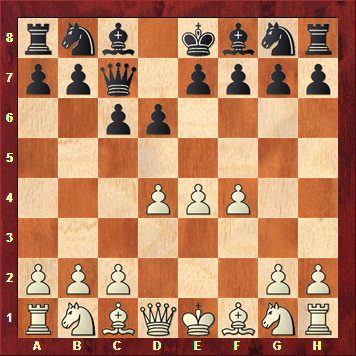


I honestly had no idea what was going on here. I thought at first he might be trying to transpose into some sort of Pirc structure, where c6 is quite commonly played by black, but if he wanted a Pirc why not play the standard Nf6 and g6 moves? After the game, I asked Carlos what the opening was and he called it the "Star Defense." I was still none the wiser until I Googled it and realized he might be referring to the S.T.A.R. Chess book by Paul Motwani. I haven't read the book but had heard of it. I am not sure if this opening is covered in there or if it's something else. Either way, it was a good way to get me out of  book early.

4. Nf3 Bg4 5. h3 Bxf3 6. Qxf3 Nd7 7. Nc3 e5 8. fxe5?!


Fritz says that this is okay for white but I was chastising myself a few moves later. Even now, I think the computer's top choice of 8. Be3  looks good. I probably rejected it automatically because it loses a tempo if black plays either 8. ... exd4  or 8. ... exf4. In reality, this was short sighted on my part and I should have kept the tension. White is already up a couple of tempi, so it shouldn't be a big deal if black captures either the d or f pawns and I have to take back with the dark squared bishop I have just moved. Additionally, one problem black has in this position is that his bishop on f8 isn't very good and might have a hard time getting into the game. By playing 8. fxe5, I am just helping black because now his bishop can get out. Finally, black has already given me the bishop pair and the position will definitely open sooner or later, whether it's because black makes a pawn capture or white does. There is no need to rush this.

8. ... dxe5 9. d5 Ngf6 10. dxc6 bxc6 11. Be3 Bb4 

I was already less than thrilled with my position. Fritz says the position is already a bit better for black, an assessment I agree with. It's much easier for black to play.

12. Bd3 O-O 13. O-O Rab8 14. Ne2 Bc5! 15. b3


I wasn't sure what else to play here. I thought black's 14th move was excellent because he is going to exchange off the dark squared bishops, thus removing my best piece from the board. My light squared bishop on d3 is not happy with life either, so I thought this position had to be better for black.

15. ... Qb6 16. Bxc5 Qxc5+ 17. Kh2 Qd6 18. Rad1 Qa3 19. Ng3 g6 

Of course, capturing on a2 would run into Ra1 and I think white would then be better.

20. Qe3 Ne8?


He we arrived at an interesting position. Black is still threatening the pawn on a2 but it's again not a true problem yet because his a7 pawn would hang after I play Ra1. I could see that black might be trying to get a knight to e6 and, from there, to either f4 or d4. Those are both juicy looking squares. In the meantime, I still have an isolated pawn on e4 but right now it's not much of a weakness (black isn't even attacking it once). The big problem white has in this position is that all of his pawns are on light squares, making the d3 bishop just plain miserable. The bishop has very little scope in this type of structure and I felt like I was almost playing down a piece. Therefore, I came up with a radical solution that would either win a pawn or at least trade off my bishop for one of black's knights. Either way, this would put me right back in the game. Fritz thinks my 21st move is the best too, so I was pleased to have found it.

21. Bb5!

This wins the c6 pawn because black's knight on d7 is hanging. Black can capture the bishop (which actually would solve the problem of his isolated c pawn) but then he would drop the d7 knight. At least then he wouldn't be down material but I figured white would have dramatically improved his position by getting rid of his worst piece (the light squared bishop) and by getting a rook to the 7th rank, where it also conveniently hits the a7 pawn.

21. ... Nc5 22. Bxc6 Ng7 23. Bd5 Nce6 24. c3 Qe7 25. Bxe6 Nxe6 26. Rd5 Nf4 27. Ra5 Rb6 28. Ne2 Nxe2 29. Qxe2 Qc7 30. Qd2? Rc6?


A tale of mutual blunders. Black should have played 30. ... Rxb3, a move I saw immediately after I played 30. Qd2. It just wins his pawn back and I would have had nothing. After the game, Carlos said he saw this but thought he would still be down a pawn because his a7 pawn would hang. I told him that was true but, as consequence of putting a pawn on c3 and my queen on d2, my c pawn would then hang too. He said he just missed that.

31. c4 Rc5 32. Rxc5 Qxc5 33. Qd5 Qe7 34. Rf3 Rd8??


A blunder in what was already a very bad position. Carlos missed a tactic that picks up a second pawn and wins the game. The rest of the game is uninteresting (I had quicker mates and, for some reason, Carlos kept playing on despite being down a queen), so I just give the moves below without notation.

35. Rxf7! Qxf7 36. Qxd8+ Kg7 37. Qg5 Qc7 38. Qd2 Kf6 39. Qd5 Ke7 40. Qg8 Kd6 41. Qd5+ Ke7 42. c5 a6 43. b4 Qb8 44. c6 Qc7 45. a4 h6 46. Qc5+ Ke6 47. b5 axb5 48. axb5 Qd6 49. Qc4+ Ke7 50. c7 Qd2 51. Qc5+ Kf6 52. c8=Q Qf4+ 53. Kg1 Qxe4 54. Qf2+ Qf4 55. Qxf4+ exf4 56. b6 Ke5 57. b7 g5 58. b8=Q+ Ke4 59. Qe6+ Kd4 60. Qd8+ Kc3 61. Qc6+ 1-0


Here is the complete PGN:


Hayes,Matthew (2124) - Luna,Carlos (1611) [B12]

Arcadia Fall Challenge Arcadia (1), 20.10.2014


1.e4 c6 2.d4 d6 3.f4 Qc7 4.Nf3 Bg4 5.h3 Bxf3 6.Qxf3 Nd7 7.Nc3 e5 8.fxe5 dxe5 9.d5 Ngf6 10.dxc6 bxc6 11.Be3 Bb4 12.Bd3 0–0 13.0–0 Rab8 14.Ne2 Bc5 15.b3 Qb6 16.Bxc5 Qxc5+ 17.Kh2 Qd6 18.Rad1 Qa3 19.Ng3 g6 20.Qe3 Ne8 21.Bb5 Nc5 22.Bxc6 Ng7 23.Bd5 Nce6 24.c3 Qe7 25.Bxe6 Nxe6 26.Rd5 Nf4 27.Ra5 Rb6 28.Ne2 Nxe2 29.Qxe2 Qc7 30.Qd2 Rc6 31.c4 Rc5 32.Rxc5 Qxc5 33.Qd5 Qe7 34.Rf3 Rd8 35.Rxf7 Qxf7 36.Qxd8+ Kg7 37.Qg5 Qc7 38.Qd2 Kf6 39.Qd5 Ke7 40.Qg8 Kd6 41.Qd5+ Ke7 42.c5 a6 43.b4 Qb8 44.c6 Qc7 45.a4 h6 46.Qc5+ Ke6 47.b5 axb5 48.axb5 Qd6 49.Qc4+ Ke7 50.c7 Qd2 51.Qc5+ Kf6 52.c8Q Qf4+ 53.Kg1 Qxe4 54.Qf2+ Qf4 55.Qxf4+ exf4 56.b6 Ke5 57.b7 g5 58.b8Q+ Ke4 59.Qe6+ Kd4 60.Qd8+ Kc3 61.Qc6+ 1–0


Friday, October 10, 2014

Ge Whizz

The final round of the Istvanyi Open took place on Monday and I had black against 12-year-old Anthony Ge, rated 1974. Anthony and I were the only two players on 4.5/5 going into the last round so we both knew the victor would win the tournament outright. Equally, we also knew that a draw would guarantee us both a tie for first.

Although I was the favorite in theory, Anthony and I had drawn our last game (where he'd had a significantly better, if not winning, position at one point). Anthony had also beaten Raoul Crisologo, a high expert, in round 5 and had drawn Dave Bassett (2300) in round 4. Additionally, I had the black pieces again, which was unfortunate because it gave me four blacks out of six for the tournament. Normally, the higher rated player would get due color so I had initially expected to have the white pieces. However, this would have given Anthony three blacks in a row, so the WinTD pairing software correctly gave him white and me black.

Last week, Raoul had lamented how Anthony was getting up and playing with his friends in the back room frequently during their game. He wasn't saying it was distracting; rather, it was just galling that Anthony had beaten him despite hardly being at the board! He would play with his friends, come back to the board, make a strong move quickly, and then go back to playing. It's quite impressive really and I wonder how much potential Anthony has, especially if he takes his games more seriously.

I did some brief preparation for Anthony and I's game over the weekend but it was difficult because I'd only had black against him once. The other three times we had played I was white. Also, in our last game I had played the Scandinavian against him, which is not an opening I play too often. I had played this because I suspected he was one of those "Alapin kids", as I have started to call them. I have noticed that a number of the kids in Arcadia play the Alapin and I don't think it's a coincidence. Most all of them have been coached by WIM Sarah Lu and perhaps Sarah likes the Alapin. It's by no means bad for white but, equally, it's hardly the most testing response to the Sicilian either.

Luckily, I knew that Dave Bassett was black against Anthony in their round 4 encounter, so I messaged him on Facebook to ask what Anthony had played. Dave was kind enough to send about the first 10 moves of their last two games and I determined that Anthony probably plays the exact same moves against almost any Sicilian move order. Sure enough, the first seven or eight moves of our game followed that trend.

1. e4 c5 2. Nf3 d6

I very rarely play 2. ... d6  in the Open Sicilian but was confident Anthony would avoid 3. d4  and would play the same way he had against Dave Bassett. Sure enough, he did. Even if he hadn't, I would have gone into a Najdorf or Dragon if needs be.

3. c3 Nf6 4. Be2 g6 5. O-O


This was the same move order as the two games Dave had shown me. I don't think it's anything for black to worry about. In fact, Fritz thinks black is already slightly better after white's third move!

5. ... Bg7 6. Re1 O-O 7. Bf1 Bg4

This was a slight improvement over the way Dave had handled this against Anthony. Dave had played 7. ... Nc6  but Fritz prefers 7. ... Bg4  (although it thinks 7. ... Nc6  is fine too).

8. h3 Bxf3 9. Qxf3 Nc6 10. d3 Qb6


The computer thinks that 10. ... d5!  is better. This was what Dave had played against Anthony earlier this year, albeit in a slightly different position where black hadn't exchanged his bishop for the f3 knight. Certainly, the d5 pawn push is very thematic for black in a number of Sicilians (not least in my favorite Hyper-Accelerated Dragon!) but I felt 10. ... Qb6  would keep white tied up for a bit. After the text move, Fritz says the position is equal.

11. Nd2 a6 12. Nc4 Qc7 13. Bg5 b5 14. Ne3 Ne5 15. Qf4 Nh5


This was a tricky decision. I was slightly concerned about the activity of white's queen, knight and bishop over on the kingside. I felt I needed to take immediate action to deter white from any further nonsense. The main drawback of putting the knight on h5 is that it's a bit out of play. I also had to be sure that white couldn't somehow trap it. As it turns out, 15. ... Nh5  is a very good move and Fritz's number one choice.

16. Nd5

This caught me by surprise and here I had my only really long think of the game. The sequence I came up with seems to be just fine for black and even contains a nasty trap at the end if white isn't careful.

16. ... Nxf4 17. Nxc7 Ra7 18. Bxf4


Probably best. Anthony looked as if he was reaching for the knight and then he saw the trap. If 18. Nd5?  there is a rude awakening after 18. ... Nxh3+! 19. gxh3 Nf3+  followed by capturing the bishop on f4 and suddenly black has won a pawn.

White could try the desperado 18. Nxb5  but then black can play his own desperado with 18. ... Nxh3+  and then capture on b5. The position would be essentially equal.

18. ... Rxc7 19. Bxe5 Bxe5 20. Rad1 Rb8 1/2-1/2


Here I offered draw because I couldn't see how black could win against any reasonable play by white. True, I have the slightly better bishop but his rooks are as active as mine and swapping them would lead to an obviously drawn opposite colored bishop endgame. Anthony accepted the draw offer without hesitation, meaning we both finished on 5/6 and shared a five way tie for first place. Anthony's rating went over 2000 for the first time, so congratulations to him. My rating went from 2124 to 2133, my highest rating ever by one point.

Here is the game PGN:

Ge,Anthony (1974) - Hayes,Matthew (2124) [B50]
Istvanyi Open Arcadia (6), 06.10.2014

1.e4 c5 2.Nf3 d6 3.c3 Nf6 4.Be2 g6 5.0–0 Bg7 6.Re1 0–0 7.Bf1 Bg4 8.h3 Bxf3 9.Qxf3 Nc6 10.d3 Qb6 11.Nd2 a6 12.Nc4 Qc7 13.Bg5 b5 14.Ne3 Ne5 15.Qf4 Nh5 16.Nd5 Nxf4 17.Nxc7 Ra7 18.Bxf4 Rxc7 19.Bxe5 Bxe5 20.Rad1 Rb8 ½–½


Thursday, October 2, 2014

More Fire From the Hyper-Accelerated Dragon

Monday night in Arcadia saw the fifth of six rounds in the Istvanyi Open. The tournament is named after Gabor Istvanyi, a one time Arcadia Chess Club player who I believed last played in the 80s or 90s. The USCF website doesn't list him as being deceased but I thought he had passed away in the 90s and that's why the tournament was named after him. I never met him but there are several people at the club who remember him.

On Monday I was paired against Tim Thompson, rated exactly 200 points below me. However, Tim has previously been rated over 2100 and had drawn expert Raoul Crisologo in round 4, so I definitely had to be on my guard.

I had only played Tim once before, in a game I won earlier this year when Tim had a perfectly fine position only to walk into a bishop skewer on his king and rook. The first seven moves of our game on Monday were identical to our earlier game but Tim then deviated. Let's take a look...

1.e4 c5 2.Nf3 g6 3.d4 cxd4 4.Nxd4 Nc6 5.Nc3 Bg7 6.Be3 Nf6 7.Bc4 0–0 8.Qd2


In our previous game, Tim had played 8. f3  which should lose a pawn to 8. ... Qb6  but I had played 8. ... d5  instead, which is also playable but not as good.

In this game, 8. Qd2  is a mistake. I considered 8. ... Ng4  which Fritz likes but ultimately settled on a well known temporary piece sacrifice which essentially equalizes for black.

8. ... Nxe4 9.Nxe4 d5 10.Nxc6 bxc6 11.Rd1 Qc7


Here white should just retreat the bishop and accept that black has equalized. However, Tim would be the first to admit that opening knowledge is not his specialty (actually, he even mentioned that before the game!) and he unwisely grabbed a pawn that turned out to be extremely hot.

12.Bxd5 cxd5 13.Qxd5 Be6

Tempting was also 13. ... Bb7 14. Qc5 Qxc5 15. Nxc5 Bxg2 16. Rg1 Bf3 Rb1  where I thought black would have an excellent position but it wasn't as clear cut as putting the bishop on e6. After 13. ... Be6, both of black's bishops are raking towards white's queenside pawns and it's hard to see how he can hold it all together.

14.Qc5 Qb7 15.f3 Rfc8


It's important to move the right rook. Psychologically, it was tempting to leave my f8 rook where it was and instead play 15. ... Rac8. However, that wouldn't be in the spirit of the position. My rook is not needed on f8 (it's not as if white has a kingside attack going) and I want to keep my a8 rook where it is because it will defend my a7 pawn in some lines. It's already evident that play is going to revolve around the queenside.

Here Tim had a decision to make. I thought he should have played 16. Qa5  but I think black is already in serious trouble. He is going to have to give the pawn back whatever he does and I can't see any good way for him to avoid dropping another pawn after that. It is also worth nothing that white still owes us a tempo when he castles too.

Instead, Tim played a move that looked tempting but I think results in him having a lost position.

16.Qa3 Bxb2 17.Rb1


This was the point but there is nothing for black to fear. I seriously considered playing 17. ... Rxc2, which indeed is Fritz's first choice, but I wondered if white could complicate matters with something like 18. Kf1 Rxg2 19. Nf2  when it's not clear if my rook is happy on g2 plus white is now threatening to capture my bishop on b2. With hindsight, I think I was probably seeing ghosts because black can always play Rb8, followed by Qd5+. Heck, even if white was somehow able to round up the bishop on b2 I think he would still be in serious trouble because black would have three pawns for the piece and white's king looks ripe for the mating out in the open.

Instead, I decided to keep things simple, let the queens come off the board, and end up in a position where black is up two pawns and completely winning.

17. ... Bxa3 18.Rxb7 Rxc2 19.0–0 a5

There is no need to capture on a2 right away. The pawn isn't going anywhere. Fritz also says that 19. ... a5  is the best move.

20.Rfb1 Bxa2 21.Rb8+ Rxb8 22.Rxb8+ Kg7 23.Ra8 Bb4 24.Bb6 Bd5


I had spent some time trying to make something out of 24. ... Rc1+ 25. Kf2 Be1+ 26. Ke2 Bc4+  but couldn't find a way to make it work. Basically, I was seeing if I could skewer his king and bishop on the g1-a7 diagonal but there isn't anything there. Therefore, I decided to play more simply.

25.Ra7 Bxe4 26.fxe4 Re2 27.Bd4+ Kh6 28.e5 Rxe5 0–1

A final blunder. Tim resigned here as white will be down three pawns with a hopeless position after 29. Bxe5 Bc5+.

Next week I will face off against 12-year-old Anthony Ge to determine the winner of the tournament. As the only two players on 4.5/5, it will be winner takes all! Anthony is already guaranteed to move up to expert when the tournament is rated, even if he loses to me, and he has had a wonderful run of results including drawing a 2300 and beating a 2100. I know I will have my work cut out for me.

Here is the complete PGN:


Thompson,Tim (1924) - Hayes,Matthew (2124) [B35]

Istvanyi Open Arcadia (5), 29.09.2014

1.e4 c5 2.Nf3 g6 3.d4 cxd4 4.Nxd4 Nc6 5.Nc3 Bg7 6.Be3 Nf6 7.Bc4 0–0 8.Qd2 Nxe4 9.Nxe4 d5 10.Nxc6 bxc6 11.Rd1 Qc7 12.Bxd5 cxd5 13.Qxd5 Be6 14.Qc5 Qb7 15.f3 Rfc8 16.Qa3 Bxb2 17.Rb1 Bxa3 18.Rxb7 Rxc2 19.0–0 a5 20.Rfb1 Bxa2 21.Rb8+ Rxb8 22.Rxb8+ Kg7 23.Ra8 Bb4 24.Bb6 Bd5 25.Ra7 Bxe4 26.fxe4 Re2 27.Bd4+ Kh6 28.e5 Rxe5 0–1


Wednesday, September 24, 2014

No Fabers From Craig in Interesting Draw

Round 4 of the Istvanyi Open tournament took place Monday night at the Arcadia Chess Club. I was paired against Craig Faber, who is literally rated one point lower than me at 2123. We had played three times before (+0 =2 -1) and on Monday, just like every other occasion, I had the white pieces.

In a similar vein to my round 3 opponent, Gordon Brooks, Craig is very easy to prepare for because he always plays the same openings, namely the Scandinavian against 1. e4 and the Dutch against 1. d4. Again, this is helpful in terms of his opponent's preparation but, on the other hand, it means Craig is very well versed in Scandinavian and Dutch theory because he is exposed to so many games in those lines.

With white, Craig always plays the London System regardless of black's response. Therefore, I decided to be cheeky and play the London against him, just to see how he would react. In our previous games, I had opened with 1. e4 twice and 1. d4 once, where I fianchettoed my kingside bishop against his Dutch setup. This time, I had prepared an interesting pawn sacrifice recommended by Cyrus Lakdawala in his book, Play the London System. Lakdawala devotes an entire chapter to playing against the Dutch (incidentally, an opening he doesn't think too highly of) and, although I didn't have time to read it all, I had played through some of the sample games and had gleaned enough information to think I would be on solid enough ground.

The day after, I had my fourth lesson with GM Jesse Kraai and we went over this game. I have paraphrased some of his comments, adding them to my own below.

1.d4 f5 2.Nf3 d6 3.Bf4 Nf6 4.h3 g6 5.e3 Bg7 6.Bc4 e6 7.g4


This is the pawn sacrifice. There are two main options for black if he wants to accept the sacrifice, both of which give him a virtually lost position already.

He can try 7. ... fxg4 8. hxg4 Nxg4 9. Ng5!  when the knight is attacked and the e pawn is falling.

Alternatively, if black tries to shut down white's bishop on c4 so that it no longer attacks e6, things turn out even worse for him after 7. ... d5 8. Bd3 fxg4 9. hxg4 Nxg4 10. Rxh7!  when black's kingside is being carved apart.

Craig was either aware of the sac or intuitively knew it was dangerous, so he wisely declined it.

7.g4 Qe7 8.Rg1 fxg4 9.hxg4 Nc6 10.Nc3 Bd7


After black's 10th move, we reached the position above. Here I was out of my book knowledge already. I knew that putting a rook on g1 was fairly standard, having seen it in one of the sample games in Lakdawala's book. After that, it made sense to put the knight on c3.

Jesse said that I should have seriously considered 11. g5  here, which really puts black's knight in an awkward position. I instinctively didn't play g5 because I figured black would just play 11. ... Nh5  but, although this move looks annoying, it's just an illusion. After 12. Bh2  the knight on h5 is horribly placed and black is virtually playing down a piece. He has no way to get the knight back into the game quickly and white still has all the trumps in the position.

As I had dismissed 11. g5, I figured I needed to castle queenside and had to decide between 11. Qd2  and 11. Qe2. Fritz says that both moves are equally good but, as Jesse said, it makes more sense to put the queen on e2 because there it defends the loose knight on f3. Therefore...

11.Qe2 0–0–0 12.0–0–0 Na5 13.Bb5


Jesse made some highly instructive comments here, both about 12. ... Na5  and also 13. Bb5. I am a little embarrassed to admit that his way of looking at this position didn't even cross my mind during the game even though, with the benefit of hindsight, his comments make total sense. When Jesse and I were going over the game, I dismissed 12. ... Na5  as being suspicious and rather artificial looking. Jesse's exact words were that he had "some sympathy for Na5", the reason being that black is cramped and wants to trade pieces. By playing 12. ... Na5, black is putting the question to white's bishop.

Equally, my assessment of 13. Bb5  was also incorrect because I felt b5 was a natural square for the bishop and there way no way black would capture it as it would bring my queen over towards the queenside where black is castled. However, as Jesse pointed out, there is an old rule in chess that the side with less space should try to trade. That way, he will free up space for his other pieces. In this position, black should want to exchange bishops for that very reason. Funnily enough, Craig obviously didn't appreciate this either because he didn't take on b5!

13. ... Rdf8 14.Bg5

After the game, Craig and I briefly analyzed it and he said he thought I would play 14. Bg5. Indeed, the computer thinks that white is still doing well here, giving a 0.4 pawn advantage. However, as Jesse pointed out, putting my bishop on g5 is another step in the wrong direction. I am basically offering to trade pieces again, which can only benefit black because he has less space.

Additionally, white has much better options such as 14. Bh2!, a move Jesse suggested and actually something I did consider during the game. However, I was already getting a little low on time here and, through inertia, playing the more forcing Bg5.

14. ... Qe8 15.Bxd7+ Qxd7


We reached the above position after black's 15th move. White is still better but it's not as good as it could have been. As Jesse said, "black owes us a tempo with his knight on a5" because it's so poorly placed. However, my next series of moves are a bit suspect. Not losing or anything but definitely not in the spirit of the position.

16.Bxf6 Bxf6 17.Ne5


This move looks nice and flashy, the point being that 17. ... dxe5 18. dxe5  and black regains the piece with a slightly favorable position. The other main idea behind this move was to keep black's queen off the c6 square, which was I was a bit concerned about. However, black is not obligated to take on e5 and I am really starting to sour what had been a very promising position.

17. ... Qe8 18.Nc4

Attempting to justify my knight sortie to e5 but why on earth would I want to trade my good knight for black's horrible knight on a5? This is a result of me not fully understanding the position and also my time trouble, which by this point was getting serious.

18.Nc4 Nc6 19.Ne4 Kb8 20.Nxf6 Rxf6 21.g5 Rf7 22.Nd2 e5 23.d5 Ne7 24.Ne4 Qa4

By now, things have gone badly awry for me. I knew that black would play 24. ... Qa4  but I couldn't see what else I could do except to take the plunge and play my Ne4 plan anyway.


25.Nc3 Qa5

A huge surprise. I had assumed that black would play 25. ... Qh4  when I am going to have trouble holding both my f2 and g5 pawns. I'm not sure if Craig saw a ghost and perhaps thought his queen would be short of squares on h4, or if he just flat out missed it (he was also getting low on time by this point).

26.Kb1 Rhf8 27.f4 exf4 28.exf4 Nc8 29.Rh1 Qb4 30.Qd2 Nb6 31.a3 Qc4 32.Rde1 Rxf4 33.Rxh7 Rd4 34.Qe3 a6 35.Qe7 Rc8 36.Rg7


The wrong piece! Correct was 36. Qf7, as Jesse pointed out, because after I capture on g6 with the queen she will be guarding my c2 pawn. Also, my rook really doesn't want to be in front of the pawn. Jesse said it's something common we tell children, "rooks belong behind passed pawns!" He is quite right, of course, and my only excuse is that I had only a few minutes left on the clock. Indeed, I'd had only 4 minutes left to make 9 moves after making my 31st move.

36. ... Nxd5 37.Nxd5 Qxd5 38.Rxg6 Rd1+ 39.Rxd1 Qxd1+ 40.Ka2 Qd5+ 41.Kb1 Qd1+ ½–½

I was surprised that Craig didn't capture my pawn on c2 and play on for a bit. He really has nothing to lose and can bail out into a perpetual check any time he wants it. During the post-game analysis he said he thought my g pawn was dangerous and he couldn't be sure if he was winning or losing if he didn't take the perpetual, so I suppose it was an understandable decision.

I thought this was a very interesting game. Looking back on it, with Jesse's comments still ringing in my ears, I think that neither my opponent or I fully grasped what was happening most of the time. I kept offering to trade pieces, despite having a big space advantage, and black kept declining despite the fact that this would have helped free up his position. On the other hand, I thought my opening preparation was pretty good and that both Craig and I fought well. A draw was the fair result in the end.

Here is the entire PGN of the game:


Hayes,Matthew (2124) - Faber,Craig Allen (2123) [A80]

Istvanyi Open Arcadia (4), 22.09.2014


1.d4 f5 2.Nf3 d6 3.Bf4 Nf6 4.h3 g6 5.e3 Bg7 6.Bc4 e6 7.g4 Qe7 8.Rg1 fxg4 9.hxg4 Nc6 10.Nc3 Bd7 11.Qe2 0–0–0 12.0–0–0 Na5 13.Bb5 Rdf8 14.Bg5 Qe8 15.Bxd7+ Qxd7 16.Bxf6 Bxf6 17.Ne5 Qe8 18.Nc4 Nc6 19.Ne4 Kb8 20.Nxf6 Rxf6 21.g5 Rf7 22.Nd2 e5 23.d5 Ne7 24.Ne4 Qa4 25.Nc3 Qa5 26.Kb1 Rhf8 27.f4 exf4 28.exf4 Nc8 29.Rh1 Qb4 30.Qd2 Nb6 31.a3 Qc4 32.Rde1 Rxf4 33.Rxh7 Rd4 34.Qe3 a6 35.Qe7 Rc8 36.Rg7 Nxd5 37.Nxd5 Qxd5 38.Rxg6 Rd1+ 39.Rxd1 Qxd1+ 40.Ka2 Qd5+ 41.Kb1 Qd1+ ½–½


Thursday, September 18, 2014

How to Lose a Drawn (or Won!) Position

It doesn't matter who you are, whether you are 600 rated junior, a 1500 rated club player, or World Champion Magnus Carlsen. At some point in your chess career, you have had an opponent totally crushed only to blunder in spectacular style and be left sitting with your head in your hands. I suspect it's happened to most of us more than we would care to admit and I know I have had my fair share of disasters where I have blown beautiful games by either overlooking simple tactics or, even worse, by relaxing and assuming a position will win itself.

I would like to share a few games of mine where this has happened and I had the black pieces in all four games. In the first two games, I was the one who ended up losing what should have been won or drawn games. In the final two games, I turned the tables on after my opponents blundered in vastly superior positions.

Game 1 - My First Swiss Game

The first position is one I have reconstructed from memory as I no longer have the game score. This was my first ever game in a weekend Swiss tournament. It was played in Portsmouth, England in about 2001. I had completely outplayed my opponent and had been sat in my chair for some time wondering when he was going to resign. I was up a rook and three pawns and just couldn't understand why he was playing on. I had just pushed my c pawn and my opponent moved his queen to e7, threatening checkmate by Qh7#  and Qf7#. I had foreseen this move and thought it was no big deal because I would just defend on the 7th rank. Surely then my opponent would call it quits!

NN - Hayes, Portsmouth 2001

Thinking I had everything under control, I flicked out 1. ... Rb7, which defended against both mating threats from white's queen. There is only one problem with this move, which I am sure you'll see. White was actually threatening a third checkmate and he slowly reached his hand towards the bishop on g6 and played 2. Bh7#.

Ouch! To make matters worse, my opponent even said, "I'm sorry" as he planted the bishop on h7. I sat there dumbfounded for a couple of minutes, wondering where it had all gone wrong. The truth was, it went wrong when I started to relax and didn't take white's threats seriously. I assumed I had a winning position, which was true, but I also assumed the game would win itself and that white would throw in the towel without making any effort. Big mistake!

Game 2 - Singing the Wrong Song

The position below was taken from a game I played earlier this year against NM Melandro Singson. I had comfortably equalized as black against his London System and we reached this position after white's 30th move:

Singson - Hayes, Arcadia 2014

Black should be completely fine here. In fact, Fritz thinks that black is just fractionally better (by less than 0.1 pawns). After the normal looking 30. ... Qd6, white would have to be a little concerned about his king's safety. It's nothing special but should be easier to play for black. Instead, I had a meltdown in time trouble and played the horrible 30. ... g5??  which loses on the spot to 31. Qxe7+. I had hallucinated that this move wasn't possible because of 31. ... Rxe7, winning white's queen, but of course white just plays 32. Rxe7+, which not only regains the queen but also picks up the a pawn to boot. Seeing that I would be down two pawns for zero compensation, I resigned right away and wished the game hadn't been on top board where so many people had crowded round!

Game 3 - Acon Artist

The third game is one where I should have been totally busted but swindled a win. In the Pacific Southwest Open in July 2007, I had had a miserable tournament. Going into the last round, I had only won one game and that was against a 1600 player. I was paired against Jennifer Acon, rated 1856 but she had been around 2000 before. She had obviously had a similarly miserable tournament and was eager to finish on a high note. For a long while, it looked as though that would be the case as she outplayed me in the middlegame and I was forced to give up the exchange to stave off her mating threats.

After 29 moves we reached the position below. In the long term this will be winning for white, not only because of the exchange but also because her queen is beautifully centralized, her rook on f1 controls the only open file on the board, and her king is much safer than mine. I had kept my knight on e5 to play for the only trick I could potentially see in the position and, fortunately for me, Jennifer fell right into it. Most moves should be good for white here. The computer assesses that both 30. Qd5  and 30. Kh1  give white a two pawn advantage. My opponent got a little greedy and decided to pile up on my d6 pawn, presumably thinking of playing for b4 and then c5 afterwards. She played the natural looking 30. Rd1. Try to work out why this is a terrible blunder.

Acon - Hayes, Burbank 2007

The answer is the surprising looking 30. ... Qxh3!!, leading to a highly favorable (probably winning) rook endgame for black after 31. gxf3 Nf3+, regaining the queen and leaving white with a shattered pawn structure. I eventually converted the ending without too many problems.

Game 4 - A Tasty Skewer

David Argall has been a regular opponent of mine for a number of years. He won most of our early encounters, back when he was a strong expert and long before I was rated over 2000. Back then, I was content to scrap for the odd draw among the numerous losses David inflicted on me. In the last few years, however, the tables have turned somewhat and, out of the last five games we have played, I have won four and the other was a draw.

In this game, I had suffered a catastrophe in the middlegame, had shed a pawn, and then bizarrely went into an endgame that was completely lost for me. I had just played 46. ... Ke6, which is a total bluff. At a glance, it looks like I am threatening to play Ra5+, picking up the rook, but this is an illusion. White should just play 47. c7  and it's all over. Sure, I can win the rook but what am I going to do when he queens his c pawn? The position is resignable for black but, then again, it had been for some time and I was playing for a swindle.

Argall - Hayes, Arcadia 2010

David obviously believed my bluff because he didn't play 47. c7. He disregarded that move, probably saw that his a pawn was inconveniently hanging, and figured that trading his a pawn for my g pawn was a fair exchange. I could hardly believe my eyes when he flicked out 47. Rxg5??, which lost on the spot to 47. ... Ra5+, skewing the king and rook. There is no hope that white can queen his c pawn afterwards either; it's simply not advanced enough and black will have no problem stopping it with his king and rook.

I hope you enjoyed these blunder-fests. It goes to show that we all make mistakes but, more importantly, that it's always worth playing on a while even in a bad position. I know some people will say it's disrespectful not to resign but let's take the first game for example. Yes, my opponent in Portsmouth was completely busted for a long time but who am I to tell him he should have resigned a game that he ended up winning? I don't believe in playing on until checkmate but I think one should at least make the opponent show that he knows how to win. Plus, you never know, he might overlook something and suddenly you have turned a lost game into a draw or win.

Tuesday, September 16, 2014

It's Better to be Lucky Than Good

Last night at the Arcadia Chess Club I faced off against long-time nemesis Gordon Brooks. Gordon and I had played each other ten times previously, with the score heavily in my favor (+5 =4 -1). However, I was extremely lucky in at least a couple of those games, taking advantage of Gordon's addiction to time trouble to turn lost or drawn positions into wins. Gordon has also been making a bit of a comeback lately; after hovering near his 1900 rating floor for a long time, he is back up to 1962. As he used to be rated over 2100, I couldn't take anything for granted.

I knew I would have the black pieces and knew that Gordon would play the English Opening. He is one of those players who is easy to prepare for, because he usually plays the same thing, but what he does play he knows very well and this can make him a dangerous opponent. I had done some preparation over the weekend but, right up until I made my first move, I wasn't 100% sure if I would play 1. ... e5 or 1. ... c5. I had prepared something in both lines based on the moves Gordon had made in our earlier games. As it turned out, I opted for 1. ... e5 and obtained what I thought was a pleasant position out of the opening but Fritz disagrees completely.

1.c4 e5 2.g3 Nc6 3.Bg2 f5 4.Nc3 Nf6 5.d3 Bb4

In a previous game of ours in this line, Gordon had played 5. Nf3?!  which is a bit dubious after 5. ... e4. 5. ... Bb4  is a standard response (Bc5 is also playable), looking to trade on c3 and double white's pawns.

6.Bd2 0–0 7.Nf3 d6 8.0–0 Bxc3

The first of several dubious decisions by me. Capturing on c3 makes more sense if white has spent a tempo by playing a3 first. I was concerned about the knight jumping into d5 but, with hindsight, I don't think this is particularly dangerous.

9.Bxc3 Qe8

A standard maneuver for black in the e5 English.

10.Qd2 h6

Probably OK but I should have seriously considered shoring up the queenside first by playing Rb8 and b6 at the earliest opportunity. 10. ... h6 does prevent black from playing his queen to g5 but I shouldn't have been so concerned about that. Black can either trade queens or drop his own queen back and play h6 later.

11.b4 Qh5 12.b5 Ne7 13.a4 Ng4

Fritz doesn't like this at all. White is starting to get some serious play on the queenside, the very side of the board I have been neglecting. Again, black would have still had decent attacking chances after securing the queenside first.

14.h3 Nf6 15.Nh2

After white's 15th move, we reached this position:


It's clear that white is counting on his queenside activity to distract black from his own play on the kingside. However, in addition to unleashing the bishop on g2, 15. Nh2  had another point: white wants to play f4. I knew Gordon wanted to play f4 and had to decide how to meet this. The computer says that black should play 15. ... f4!  himself and, even though white is slightly better, there's not too much in it. Unfortunately, I decided to be hyper-aggressive and banged out the scary looking but incorrect...

15. ... g5 16.f4 gxf4 17.gxf4 Ng6 18.e3

Which lead us to this position:
 
 
The position is now becoming critical and I realized I had committed one of GM Jesse Kraai's cardinal sins, namely playing with my "pretty pieces" before I had completed my development. True, the bishop on c8 does potentially play a role in the attack but my rook on a8 isn't too happy, especially with white's g2 bishop eyeing it. I should just bite the bullet and play 18. ... Rb8  and then develop the bishop to d7 or e6. Instead, I decided to be flashy but made a crucial miscalculation. I decided I would sac the exchange on a8 in return for winning white's h pawn. This wouldn't have won a pawn, since black would also win my b7 pawn, but I thought it would open his king up enough to give me some chances. This was really playing "hope chess" in many ways because, if we look at the force count over on the kingside, black will have at best four attackers (the queen, rook and both knights) but that won't happen immediately because I'm going to spend two tempi capturing the bishop on a8 once it takes my rook and then moving it back to f8. In the meantime, white already has queen, rook and knight defending his kingside and it's easy to get the other rook involved via a2. Watch what happens...

18. ... Be6 19.Bxb7 Qxh3 


Here I have missed my last chance to bail out and just accept being down a pawn and having a significantly worse position. If I had moved the a8 rook to safety instead of sacrificing the exchange, black is much worse but I can play on. Instead, I had played 19. ... Qxh3  thinking I would have reasonable compensation for the exchange due to white's insecure king and my dangerous looking knights. In reality, white's king would be perfectly safe tucked away on h1 and my king's safety isn't much better. It's nowhere near enough for the exchange.

Here's what I had missed:

20.Bxa8 Rxa8 21.Qg2!

And I have a major problem. I had hallucinated that this move wasn't possible because of 21. ... Qxe3+  but it doesn't work. White will just play 22. Kh1  and suddenly my a8 rook and g6 knight are en prise. Black would be totally busted. This was another consequence of my dubious g5 pawn push earlier in the game; opening the g file has been to white's benefit, not black's.

Funnily enough, Fritz says that 20. Rf3  is even better when black's queen is suddenly in danger of being trapped. The text move is still winning, however.

After white's 21st move, I knew I was dead lost with the queens coming off the board but what to do? All I can do is play on and try to find some way to generate complications.

21.... Qxg2+ 22.Kxg2 Kf7 23.fxe5 dxe5 24.Nf3 Ng4

At least now I am finally following all of the computer's top recommended moves. Better late than never! After black's 24th move we reached the position below. Gordon was starting to get a bit low on time (as was I) and he had cracked in time pressure in some of our games in the past. White should play 25. Rfe1  but Gordon played 25. Rae1  instead. At a glance, it looks natural to want to keep the rook on f1 where it is because it opposes black's king on f7. However, there is no real way to exploit that at the moment and we'll see in a moment why 25. Rae1  is a mistake.


25.Rae1 Rd8!

White suddenly has problems holding all of his pawns.

26.d4 Bxc4 27.Nxe5+ N4xe5 28.Rxf5+ Ke6

Here Gordon's time pressure was getting severe and he had a total meltdown. He should just concede that things have gone awry and play 29. Rxe5+ Nxe5 30. dxe5  and we reach an endgame where white is up a pawn but black has excellent drawing chances. Psychologically, that's a tough adjustment to make when white was winning only a few moves ago. Instead, Gordon opts to go into a position where black has two pieces for a rook and is much better.

29.Rh5 Nd3 30.Rd1

And we reached the position below. Black to play and win.


30. ... Ndf4+ 31.Kf2

Compounding the problem. White needs to play 31. exf4  so at least he is only dropping the exchange and not an entire rook.

31. ... Nxh5 32.Rh1 Rf8+ 33.Ke1 Ng3 34.Rxh6 Rf1+ 35.Kd2 Ne4+ 36.Kc2 Rf2+ 0–1

Gordon resigned. Even though black isn't winning a piece immediately (if I take the c3 bishop my knight on g6 hangs), black can just play the calm 37. ... Kf6  (after white's king moves out of check) and white is down two pieces, his bishop is still en prise, and is king is close to being in a mating net too.

This was a very curious game, probably quite typical of amateurs where the advantage shifted dramatically from one side to the other in the space of a few moves. I was not at all happy with how I played up to move 22 but, once I had calmed down and realized that, yes, my position was objectively lost but I could still create some complications, I felt I played quite well. I was certainly aided by Gordon making a number of terrible blunders, which can at least partly be explained by his time trouble. The crowd of people that had gathered around to watch the game only increased the tension.

I will look forward to my next encounter with Gordon. Our games are usually very interesting and this wasn't the first time I had gotten out of jail, so to speak. In fact, it was at least the third time (although ironically, in our last game it was the other way around where I had thrown the game away after absent mindedly walking into a pawn fork on my king and rook).

 Here is the complete PGN:


Brooks,L Gordon (1962) - Hayes,Matthew (2124) [A25]

Istvanyi Open Arcadia (3), 15.09.2014

1.c4 e5 2.g3 Nc6 3.Bg2 f5 4.Nc3 Nf6 5.d3 Bb4 6.Bd2 0–0 7.Nf3 d6 8.0–0 Bxc3 9.Bxc3 Qe8 10.Qd2 h6 11.b4 Qh5 12.b5 Ne7 13.a4 Ng4 14.h3 Nf6 15.Nh2 g5 16.f4 gxf4 17.gxf4 Ng6 18.e3 Be6 19.Bxb7 Qxh3 20.Bxa8 Rxa8 21.Qg2 Qxg2+ 22.Kxg2 Kf7 23.fxe5 dxe5 24.Nf3 Ng4 25.Rae1 Rd8 26.d4 Bxc4 27.Nxe5+ N4xe5 28.Rxf5+ Ke6 29.Rh5 Nd3 30.Rd1 Ndf4+ 31.Kf2 Nxh5 32.Rh1 Rf8+ 33.Ke1 Ng3 34.Rxh6 Rf1+ 35.Kd2 Ne4+ 36.Kc2 Rf2+ 0–1


Monday, September 15, 2014

Introduction Part 6: A Local to SoCal

After the Blacknight Memorial Day event, I played in two more tournaments in 2004. In July I travelled six hours from the Monterey area to Los Angeles for the 44th Pacific Southwest Open. Here I made the mistake of getting very little sleep (a real killer for most people's chess creativity) and paying the price by losing the first two rounds. I did win the rest of my games after that but the damage was done and I finished outside the prizes. Regardless, I loved every minute of it because I stayed at the LAX Hilton, where the tournament was being held, and met several new chess friends. I may post a later blog on this tournament and the lessons I learned.

In October 2004 I "played" in the Burlingame Open near San Jose. I hesitate to use the word "played" simply because I withdrew after the first round following a total debacle against a 1500. This would be the only time I would withdraw from a tournament after one bad game, although I have since withdrawn after a series of good  games in order to protect my rating. I then played no further rated games for over a year.

Playing black against Bob Head at the
Arcadia Chess Club.
In August 2005 I moved to Southern California to start a new job. I quickly started looking around for a chess club and found that the chess scene in the Los Angeles area is quite vibrant. It's not on the same level as New York but there are many clubs and a lot of strong players. I soon settled on the Arcadia Chess Club, where I have been playing ever since. The club meets on Mondays at 6:00pm and, because there are a number of strong experts and masters who have played there, my chess education grew in leaps in bounds. I was rated 1682 in my first tournament in Arcadia, the Richard Morris Memorial in December 2005, and went as high as 2132 (currently 2124). Admittedly, that 450 point jump came over a period of about eight years but, on the other hand, I was in my late 20's and early 30's and it is not easy to gain so many points when one is older. True, I was not old physically but, in chess years, most people make that kind of progress when they are a teenager and not well into adulthood. Oh to be one of those kids who gains hundreds of points and makes expert in their early teens or sooner!

This marks the end of the introduction to my chess career thus far. My future blog posts will focus mostly on my current chess activities, analyzing recent games and so forth. I will also make some posts about past games but they won't follow any particular chronological order like the introduction has.